Why a Social Media Calendar Fails Without Local Context
Most content plans do not fall apart because the team ran out of ideas. They fall apart because the calendar was built around internal availability instead of the weeks when customers in this market are actually paying attention. A restaurant on a busy corridor, a dental practice near a transit line and a B2B supplier in an industrial park do not share the same peak weeks, and one generic posting rhythm serves none of them well.
That is the point where planning a social media calendar stops being a scheduling task and becomes a business decision. Before a single caption is written, you need to know which weeks carry the revenue weight for your sector, which weeks are quiet enough to test something new, and which moments deserve preparation instead of a reaction posted three days late.
Chicago makes this harder than it looks from the outside. The city is dense, it runs on several overlapping business calendars at once, and commercial activity spreads across downtown districts and dozens of neighborhood corridors rather than concentrating in one place. A calendar that ignores that structure tends to publish into silence during your strongest weeks and scramble during your slowest ones.
Reading the Business Cycles of a Large City Market
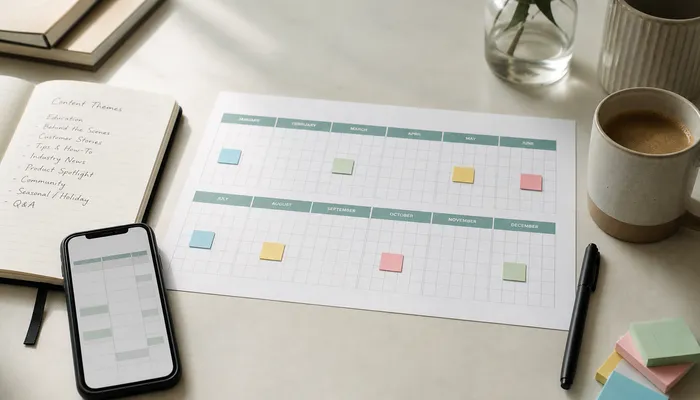
Start by drawing your own year instead of borrowing someone else’s template. The useful question is not when you feel like posting, but when your customers make decisions, ask for quotes, book appointments or choose where to spend. Those moments are specific to your sector, and they repeat with enough consistency that you can plan around them.
Hospitality and restaurants move with weather, event traffic and the weekend rhythm of their immediate area. Retail and e-commerce follow a blend of traditional shopping peaks and locally driven surges tied to neighborhood activity. Professional services and B2B work rarely move with the weather; they follow fiscal quarters, budget approval cycles and referral timing. Home services sit somewhere in between, driven by seasonal maintenance and the practical reality that nobody schedules exterior work in the middle of a cold snap.
Once those windows are mapped, translate them into three or four content themes per quarter. Each theme should be broad enough to produce several weeks of material and specific enough that a customer would recognize it as relevant. Between the seasonal themes, keep a layer of continuity content about who you are, how you work and the questions clients ask most, so the calendar never goes quiet while you wait for the next peak.
Language is a second layer worth deciding early rather than improvising later. Chicago’s audience is not monolingual, and city-level profiles such as the Census Reporter profile for Chicago, along with the underlying American Community Survey tables, can help you understand the composition of the market before you commit to a second-language track. Decide it once, deliberately, and build it into the cadence instead of bolting it on when a post suddenly needs a translation.
A Practical Monthly Planning Rhythm
A calendar that exists only as a final list of posts is a schedule. A calendar that exists as a repeating rhythm is a system, and the difference shows up in the third week of every month, when most teams either coast or panic.
Strategy block. One working session per month sets the themes, the offers or services worth featuring, the formats you will use and the one message you want a new follower to remember. This is also where you decide what not to publish, which is usually the harder call.
Production block. Capture and drafting happen in batches. Filming several short videos or photographing a set of products in one session is far more efficient than doing it piece by piece, and it protects the calendar when a busy week hits.
Review block. Approvals, edits, scheduling and a short plan for how comments and messages will be handled. Without this block, drafts pile up unpublished and community responses wait until someone has a free afternoon.
Lock the majority of the month in advance and keep a deliberate slice open for real-time moments: an unexpected weather shift, a local event worth acknowledging or a question that keeps coming up in your inbox. The reserve space is what makes the calendar flexible without making it reactive.
What You Need to Prepare Before the First Month
The first month of any content calendar is usually lost to logistics rather than creative work. Clearing those items in advance is what separates a plan that launches from a plan that slips by three weeks.
- Access to the accounts you want to publish from, including any business profiles you have not claimed yet.
- Brand material you can actually use: logos, fonts, color references and photos that are not locked in someone’s personal phone.
- Straight answers about what you sell, what it costs to deliver and which services deserve more visibility this quarter.
- A named approver, an approval window in working days and the channel where approvals happen.
Then agree on how changes get handled. Every calendar needs a cut moment after which edits move to the reserve slot instead of delaying the whole schedule. That single rule prevents most of the friction that shows up between a marketing team and a business owner during a busy week.
Where a Managed Calendar Fits
Not every business should hand over its calendar, and not every business should keep it in-house. If you have someone who already understands the audience, can hold a publishing rhythm and has the time to batch production, keeping planning internal is usually the right call. If content gets pushed to the end of the week, if the last post went out a month ago or if approvals stall every cycle, the bottleneck is process rather than talent.
That is the gap a managed program is built to close. You can see how planning works when you collaborate with a social media team based in Chicago, including the strategy rhythm, the monthly production cycle and the reporting that comes with it. Because the work is delivered remotely, planning happens through shared documents, scheduled calls in Central Time and a review cadence both sides can actually keep, rather than depending on in-person meetings.
If you would like a second opinion on your calendar before the next quarter starts, share your industry, the channels you already publish on and the seasons that matter most to your revenue. That context is usually enough for a useful first conversation, and you can reach the team here whenever you are ready to talk it through.