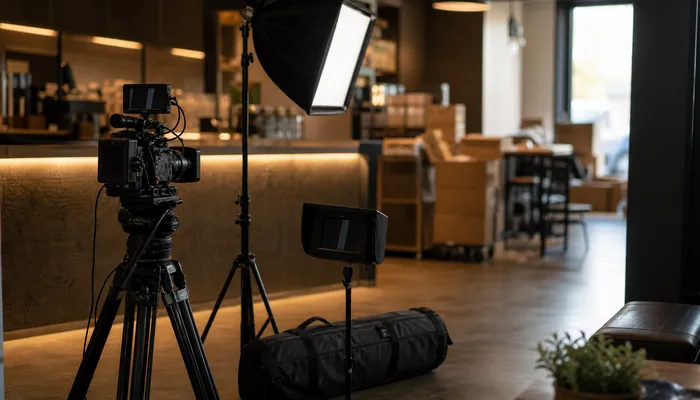
An empty dining room at two in the afternoon costs a restaurant far less than a locked door on a Friday night. That arithmetic is why so many owners assume video has to wait for a slow season — and why filming at your business without closing is usually a scheduling problem rather than an operational one. Most commercial shoots do not need a full shutdown day. They need a few controlled windows, a clear list of what must happen inside each one, and a crew that understands how a working floor actually behaves.
That is the premise behind onsite production. The team travels to your location, builds the set inside the space you already run, and works around the operation instead of pausing it. Everything below assumes that model: real staff, real fixtures, real surroundings, captured in blocks that fit the way your business already moves through a week.
Why Onsite Shoots Fit Businesses That Stay Open
Shooting on an external stage gives you control over light, sound and background. Shooting inside your own operation gives you something a stage cannot manufacture: proof. A patient intake area, a service bay, a tasting counter or a warehouse aisle reads as authentic because it is. Viewers recognize the difference even when they cannot name it, and that recognition is often the entire reason a business chooses an onsite shoot over a studio build.
The trade-off is complexity. On a stage, nothing unexpected walks into frame. At your location, customers, deliveries, phone calls and equipment noise are part of the environment. Good planning does not remove those variables; it sorts them. Some material can only be captured when the space is quiet and empty, and some material is better captured while the business is genuinely busy, because the movement is real.
Creaxiones works as a Chicago-based team with a single office at 1928 N Leamington Ave, Chicago, IL 60639, used as the operational base for onsite work. That matters to scheduling: load-in, travel between locations and crew call times can all be planned around the city’s geography rather than improvised. Chicago’s range of commercial environments — dense downtown floors, neighborhood retail strips, industrial corridors and lakefront settings — also means the location itself often does work that would otherwise need to be built. For background on the city as a market, the Census Reporter Chicago city profile and the U.S. Census Bureau’s American Community Survey tables are useful public references, though they describe the population rather than any individual business.
Splitting The Shoot Around Your Operating Hours
The most practical structure for a business that cannot close is a split day. Instead of asking for eight continuous hours, the production is divided into short windows that sit before opening, inside a natural lull, or after the last customer leaves. Each window has a defined shot list, and anything not captured in one window is either rescheduled or shot in the next.
Early morning blocks, before the doors open, are the cleanest option for wide shots of an empty space. Rooms are quiet, floors are clean, and natural light from street-facing windows is usually at its most even. This is the window for anything that requires an uninterrupted frame: a slow push through a showroom, a full-room establishing shot, a silent walk-through with no ambient traffic noise.
Mid-afternoon lulls work well for counter and service interaction. A two-to-four window often has enough staff on hand to keep normal service running while a small footprint of gear sits off to the side. This is where hands, tools, product handling and short process sequences get captured, usually with a narrow lens and a tight frame so that surrounding activity stays out of the composition.
After-close blocks are best for anything involving audio or evening atmosphere. Interviews, spoken lines and voice-over recording all benefit from a building that is not vibrating with HVAC load, foot traffic or a dishwasher cycle. Exterior signage, storefront approach shots and evening lighting also belong here, because the streetscape at that hour matches the way customers actually experience the business.
The sorting rule is simple. Shots that need silence, space or a specific moment go into a controlled window. Shots that show the business doing what it does every day can be captured live, with the crew working around customers rather than asking customers to work around the crew.
What The Crew Needs From You Before Cameras Arrive
Preparation is where the disruption is actually reduced. Most shoot-day friction comes from information that was never shared, not from equipment. A short pre-production conversation covers four things.
Access and movement. Where the crew parks, which entrance or freight door to use, whether there is an elevator or a stairwell, how far equipment has to be carried, and who holds keys, codes or alarm access. If the location has a service corridor, that route is usually faster than walking gear through the front of the house.
Power and environment. Outlet locations, how much load those circuits can carry, whether lights and monitors will trip a breaker, and how loud the space is when systems are running. A compressor or a make-up air unit can be the difference between interview audio that is usable and audio that needs heavy repair.
Zones that stay out of frame. Whiteboards, price sheets, unapproved packaging, competitor products, screens showing internal data, and any area that is mid-renovation. It is far easier to know this in advance than to discover it in the edit.
People and assets. Who will appear on camera, whether releases are needed, how long each person can realistically step away, and who the backup is if a shift changes. Alongside that: logo files, approved brand assets, product samples, uniforms or menus that should appear. The industries that most often need this level of coordination are Healthcare and Med Spa, Professional Services, Home Services, Hospitality and Restaurants, Retail and E-commerce, and B2B and Industrial — mainly because each one has a version of “we cannot stop working today” that has to be respected.
With 25+ years of team experience across marketing, strategy and technology, the review process is usually a matter of confirming what the client already knows about their own operation. The crew’s job is to translate that into a shot plan, not to ask the business to behave differently.
Reviews And Approvals Outside The Workday
The other half of the continuity problem happens after the shoot. Cuts need to be reviewed, and the people whose opinions matter are usually the ones standing on the floor during business hours. Left unmanaged, that gap is where projects slow down.
Two habits prevent it. The first is a single reviewer. One person consolidates feedback from the owner, the marketing lead and anyone else with a stake, and sends it back as one set of comments rather than a thread of overlapping opinions. The second is time-stamped notes. Comments tied to a specific moment in the timeline are unambiguous, and they eliminate the long back-and-forth that happens when feedback describes a scene instead of pointing at it.
Meetings are scheduled Monday through Friday, 9:00 AM – 6:00 PM Central Time, with after-hours meetings available by appointment. That last part exists for exactly this situation: a review call at 7:30 p.m. after the last customer leaves is often more productive than trying to pull three people off the floor at midday. Documented comments, agreed decision-makers and short review windows keep a project moving without asking anyone to leave their post.
Planning The Next Shoot Around Your Season
Once one shoot is complete, the smartest next step is usually not to book another one. It is to inventory what you already have. Footage of a service process, a product line or a room rarely expires quickly. New music, tighter editing and different aspect ratios can extend the life of existing material for social, web and paid placements before a single new frame is captured.
When a new shoot does make sense, the season decides the window. Hospitality and restaurants generally prefer the shoulder weeks before a peak period, so the footage is ready when demand arrives. Retail often works best just ahead of a launch or a seasonal reset, when the space is already staged. Home Services and B2B and Industrial teams tend to get the most from scheduling during a predictable production lull rather than mid-project. If you want a structural starting point for that timing decision, the guide on timing a production around your busy season walks through the same logic for content calendars.
If this is your first onsite shoot, it also helps to read up on site logistics to settle before the crew arrives and on how an on-location shoot day runs in Chicago. Both posts cover the parts of the process that happen before and during the visit, so this one can stay focused on protecting your operating hours.
When you are ready to compare options, the practical move is to outline scope before dates: how many final videos you need, where they will run, who will appear, and which parts of the week are realistically available. That conversation is enough to plan an onsite commercial shoot with a Chicago-based team without committing to a schedule. If you would rather start with questions than a brief, reach out to the team and share what your operation looks like on a normal day — that is the detail that shapes everything else.
A shoot that respects your operating hours is not a smaller production. It is a better-planned one.